Picture this. A buyer has evaluated three vendors. They've made their decision. They email the seller on a Tuesday: "We're ready to move forward. Can you send us a proposal?" Two weeks later, they're still waiting. Not because the seller forgot. Not because the product doesn't exist. The seller is running around internally — figuring out which exact configuration the buyer qualifies for, what discount they're allowed to offer, whether the deal needs a manager's sign-off, and who that manager is this week. By the time a proposal lands in the buyer's inbox, the buyer has already started second-guessing their decision. One of them has taken a call with a competitor who just... sent a number. That is the problem. A buyer who wanted to buy, couldn't — not because of the product, but because of the internal machinery between "yes" and "here's your price."
What is actually happening inside that two-week wait
From the outside, it looks like the seller is slow. From the inside, the seller is lost.
Most B2B companies sell complex products — different tiers, add-ons, regional pricing, volume discounts. The rules that govern what can be offered to which buyer, at what price, with whose approval, exist somewhere. But "somewhere" usually means a mix of spreadsheets, old emails, tribal knowledge, and the one RevOps person who has been there long enough to remember why the rules exist.
So when the seller sits down to build a proposal, they are not typing. They are investigating. They are asking around. They are hedging by pricing conservatively so they don't get flagged. And if they do apply a discount, they trigger an approval chain that can take days — after the buyer has already seen a number that might change.
The buyer waiting on the other end has no visibility into any of this. All they know is: they said yes, and nothing has happened.
This is not one person's problem to fix
It is easy to look at this and say: give sellers better tools so they can move faster. That would help a little. It would also miss the point.
The seller is not slow because they type slowly or forget to follow up. They are slow because the information they need — what to offer, at what price, with what approval — does not live anywhere they can find it at the moment they need it. Fixing the seller's interface without fixing where the rules live just produces a faster path to the same confusion.
And the seller is not the only stakeholder who matters here.
RevOps built those pricing rules for a reason. Discount levels, approval thresholds, valid configurations — these exist to protect margin and keep commitments consistent across every deal the company signs. If sellers work around them because they're too hard to find, RevOps has a problem. If sellers make offers the company can't honor because they guessed at the rules, Finance has a problem. And if the buyer waits two weeks for a proposal that then has to be corrected, the company has a trust problem.
A solution that makes the seller faster while making everyone else's job harder has not solved the problem. It has moved it somewhere less visible, where it will surface at a worse moment.
What should actually be possible
If this is working well, a seller who finishes a good conversation with a buyer should be able to build a valid proposal — right configuration, right price, right approval status — before that buyer has time to cool off.
Not by guessing. Not by Slacking the one person who knows. By having the right rules surface at the right moment, so the seller can move with confidence instead of caution.
RevOps should be able to change pricing logic without retraining every rep, because the rules live in a system, not in someone's memory. Finance should see margin exposure before the proposal goes out, not after the contract is signed. And the buyer should receive something that reflects what they actually asked for — a number the company will stand behind.
That is the behavior worth protecting. Not "faster proposals." A clean path from a buyer who is ready to a proposal the company can commit to.
The product decision most teams get wrong
When companies try to fix this, they usually ask: how do we help sellers create proposals faster?
That question produces the wrong product.
A tool that helps sellers generate proposals faster — better templates, smarter drafting, cleaner formatting — moves the visible part of the problem without touching the real one. The proposal still might be wrong. The approval chain still might take a week. The buyer still waits.
The better question is: how do we reduce the time between a buyer's intent and a proposal the company has already approved?
That question leads somewhere different. The work is not in the proposal itself. It is in making the rules findable, the configurations valid by default, and the approvals visible before they become blockers. The proposal is the last step. Everything upstream of it is the actual product.
Where it is actually breaking
Three things tend to be broken when a company has this problem.
The rules are not accessible at the moment the seller needs them. Pricing logic, approval thresholds, valid configurations — they exist, but they live in documents no one reads, institutional knowledge no one has written down, and the inbox of a RevOps manager who is also handling six other things. So sellers estimate. And then they correct. And sometimes they correct after the buyer has seen the wrong number.
Approvals are triggered too late. The seller builds the proposal, applies a discount, and only then discovers it needs sign-off. The approval request goes out after the buyer is already expecting a final number. Now the buyer is waiting on something the seller does not control.
Pricing knowledge is concentrated in a few people. Every non-standard deal becomes a personal favor and a Slack thread. The seller with the best relationship with RevOps closes deals faster — not because they're better at selling, but because they have faster access to the same information everyone should have.
None of these is a proposal problem. They are a rules-and-access problem. And that distinction completely changes what you build.
Where technology helps — and where it causes damage
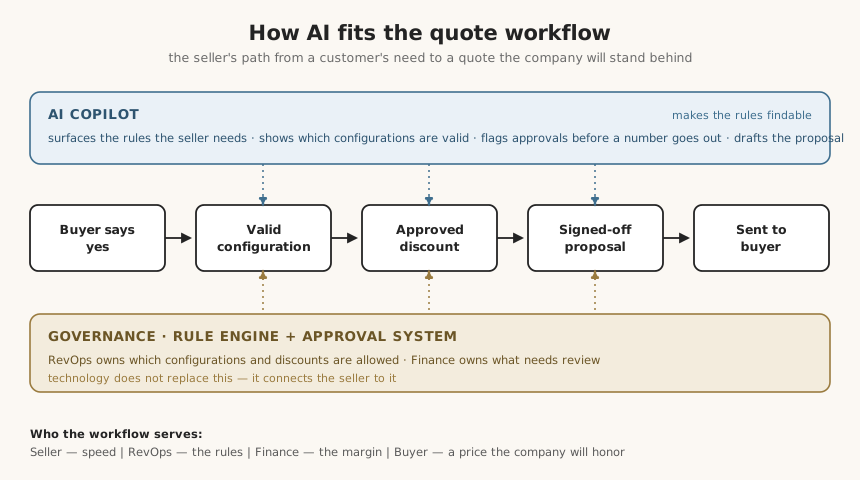
The tempting move is to put AI on top of this and have it generate proposals automatically. Faster output, less effort, deal velocity improved.
The problem is that AI generating proposals is not the same as AI generating valid proposals. An invalid proposal that arrives quickly is worse than a slow one — it creates a commitment the company cannot honor, damages trust with the buyer, and triggers a correction process more expensive than the original delay.
The right role for technology here is narrower and more useful. Not to replace the rules. To make them findable.
If a seller can describe what the buyer needs and immediately see which configurations are valid, which discount level applies, and whether this deal needs approval before a number goes out — that is the problem solved. The seller moves faster not because the rules changed, but because they no longer have to hunt for them.
The rules still come from RevOps. The approval decisions still come from Finance. Technology connects the seller to those decisions at the moment they need them, instead of making the seller chase them down after the fact. That is a fundamentally different — and much safer — product bet.
How you know it is working
The north star is time-to-approved-proposal: how long it takes from a buyer expressing intent to a proposal the company has signed off on going out the door. Not how many proposals were sent. Not how fast the seller typed. Whether the full path — from "we're interested" to "here's a number we'll honor" — is getting shorter.
The leading indicators tell you the path is improving before the north star moves. Are sellers flagging approval requirements earlier, before a number reaches the buyer? Are valid configurations being selected on the first attempt rather than corrected after? Those signals show up quickly and tell you the right information is reaching sellers at the right moment.
The lagging indicators confirm the improvement is real. Proposal correction rate — how often a proposal has to be revised after it's sent — tells you whether accuracy is genuinely improving over time. Approval cycle time — how long a deal takes to clear internal review — tells you whether the bottleneck upstream of the buyer is actually shrinking.
The countermetrics are where things look fine until they suddenly aren't. Discount leakage — the average discount offered drifting upward as the system makes applying discounts easier — means speed is being purchased with margin. Approval override rate — managers waving deals through rather than reviewing them — means governance is eroding without anyone declaring it. If either climbs, the product is failing quietly. Deals look like they're moving. The business is taking on risk it cannot yet see.
Those countermetrics are the kill switch trigger. If they climb past a defined threshold, pull back autonomy — require more review, narrow what sellers can offer without sign-off — until trust is re-established. Speed is not the goal. Speed with valid proposals is the goal. The metrics exist to tell you which one you are actually getting.
How to ship this without creating new problems
Start narrow. One product line, one sales team, one set of approval rules. Make sure RevOps has reviewed the logic before sellers depend on it. Make sure Finance has defined what counts as a margin risk before the system starts surfacing discount options.
Then measure. Did proposals go out faster? Did they require fewer corrections? Did the approval queue get shorter or longer?
The broader rollout earns its way by proving the first version moved deals without letting commitments drift. A company that skips that proof and ships broadly is making the same bet the seller made when they guessed at the rules — and hoping no one notices until after the proposal goes out.
The real insight
A buyer who is ready to purchase should not wait two weeks for a price.
That wait is not a seller discipline problem. It is a systems problem — rules that are not findable, approvals that are not visible, pricing knowledge that lives in people's heads instead of products. The seller is not slow. They are navigating something that was never built to be navigated quickly.
Fixing it means building for the whole system: rules that surface at the moment the seller needs them, approvals that happen before a number reaches the buyer, and margin visibility that Finance can trust. The proposal is easy. Everything that makes the proposal valid is the actual product.
Get that right, and the two-week wait becomes twenty minutes. The buyer gets what they wanted. The company commits to something it can honor. And the seller gets to do the one thing they were hired to do — close the deal, not chase the paperwork.